The Driver of Adaptability: How Grit Sustains Us During Workplace Changes

Grit is often mistaken for “grinding”: working long hours until exhaustion. While this can be one of the behaviors exhibited by someone with a lot of grit, it doesn’t capture the full picture of this ability. Grit is defined as:
- A measure of our passion and our desire to persevere in sustaining it.
In the context of Workplace adaptability, Grit helps us understand how long we will last amidst periods organizational change.
In this article, I will explore how this ability fits into the broader picture of Workplace Adaptability. I’ve shared a free, short quiz you can use to measure your Grit. We encourage you to measure your full Adaptability Quotient (AQ) with the AQai assessment for deeper insights.
What is Grit?
To understand the essence of Grit in the context of workplace adaptability, you only need to look back to the workshop of Thomas Edison.
Edison famously remarked, “I have not failed. I’ve just found 10,000 ways that won’t work.” Edison’s quote embodies key aspects of Grit. In his journey to perfect the incandescent lightbulb, his passion and perseverance helped him continue working towards a long-term goal.
Imagine how differently Edison would sound if instead he said, “I’ve tried three different ways. I think we should stick with candles – everyone knows how to use them anyway.” If Edison had made this statement, someone else’s name would likely be credited with inventing the lightbulb. Now, let’s dig into the “why” behind Edison’s 10,000 attempts to create a lightbulb.
Purpose + Alignment = Passion
We’ve stated that Grit isn’t just about working hard – that is certainly one characteristic of grit, but it’s not the driving characteristic. Instead, the defining ability of grit is the capacity to see a future in which any struggle or setback is offset by a higher quality of life or work. This is often defined as passion.
Going back to Thomas Edison, he wasn’t the first inventor of a device that allowed electricity to produce light. There were many competing devices available, but they were very expensive. Edison’s vision for the lightbulb allowed him to imagine a world that democratized light. Before the lightbulb, the world was essentially governed by the setting sun, and if you could afford it, the dangerous fumes of gas lamps. Edison imagined a world free from darkness.
Now that’s a strong vision and one that can produce a lot of passion.
This context helps to explain why Edison spent days and nights working on the lightbulb. Creating a lightbulb wasn’t just a hobby; it was a piece of his life’s mission.
Incremental Wins & Purposeful Practice
It’s important to dig into what Edison’s 10,000 “failures” really mean. On the whole, this number sounds scary. However, Edison didn’t start by making a list of 10,000 ways to make a lightbulb, and, unfortunately, it took him all 10,000 tries to get it right.
No, Edison viewed each material as a single test to explore. His failures, then, go from 10,000 tests to one test, repeated as many times as it takes to get it right.
Runners who attempt a marathon often align with this mantra, saying “just one step at a time”.
This is how this concept can be applied to skill development rather than to creating a product or device. Musicians, for example, will deliberately practice specific parts of their music to ensure it sounds exactly as they want it to, rather than practicing the whole piece over and over again.
Micro-goals, therefore, allow you to systematically work towards a larger goal. When you are willing to try one more test, take one more step, practice one more chord, you lose track of how long you’ve worked towards your goal.
Resilience and Recovery
In 1914, a massive fire erupted at Edison’s laboratory. Edison was 67 years old and was quoted to have said to his son, “Go get your mother and all her friends. They’ll never see a fire like this again.” The next day, Edison began rebuilding his laboratory.
The burning down of a building could demoralize any property owner, let alone an inventor with many unfinished projects. Edison approached it with humor and knew immediately that rebuilding could give him new opportunities.
Many athletes are known to show this type of resiliency as well. NFL Eagles quarterback Jalen Hurts kept a picture of himself walking through red and yellow confetti (the colors of the opposing team) when the opposing Super Bowl team won. Rather than let a major setback derail him, Hurts used the experience to motivate himself to work harder. He won the Super Bowl 2-seasons later.
How Does Grit Impact Workplace Adaptability?
Grit isn’t an ability that solely affects individuals. It’s possible to assess a team’s and an organization’s level of grit. It’s important to understand how gritty a team and organization is during times of intense change. Grit can have both positive and negative impacts on organizations.
When Grit Harms Teams and Organizations

Blockbuster Video serves as a cautionary tale of what happens when grit is applied to a sinking ship. Their downfall wasn’t due to a lack of effort, but rather an abundance of “misplaced grit”. Blockbuster was committed to preserving a storefront-centric world that their customers had already outgrown.
By the mid-2000s, Blockbuster possessed an incredible operational engine and a team that worked tirelessly to optimize its brick-and-mortar footprint. However, they funneled their stamina into defending an obsolete business model:
The Refusal to Unlearn:
They showed immense grit in attempting to merge their physical and digital worlds through “Total Access,” yet they could never bring themselves to abandon the high-margin “late fee” revenue that kept their 9,000+ stores profitable, but their customers resentful.
Their leadership possessed the “grit” to fight a war on two fronts (Netflix and Redbox) while refusing to shutter their physical legacy and pivot fully to streaming.
Today, Blockbuster is studied not as a lazy organization, but as a rigid one. They had the engine (Grit), but they lacked the steering (AQ), proving that in a dynamic market, the only thing more dangerous than giving up too early is refusing to pivot at all.
When Grit benefits Teams and Organizations
We can see how unchallenged Grit can sink an organization. Let’s look at the other end of the market, where Netflix channeled grit to stay the course and become the massive giant they are today.
When Netflix launched its DVD-by-mail service, Wall Street analysts called it “a worthless piece of crap.” The company was hemorrhaging money, and in 2000, they famously tried to sell themselves to Blockbuster for $50 million. They were laughed out of the room.
Instead of folding, the team used that rejection as fuel. They grittily refined their “subscription model” and scrapped late fees—the very thing that made Blockbuster profitable but unloved.
By focusing on the customer’s “Why” (convenience over penalty), they outlasted the giant that had mocked them.
How to Measure Grit on Teams
When trying to understand your team’s Grit, it’s essential to consider it in the context of other adaptability areas, such as Mental Flexibility, Mindset, Resilience, Unlearn, and more.
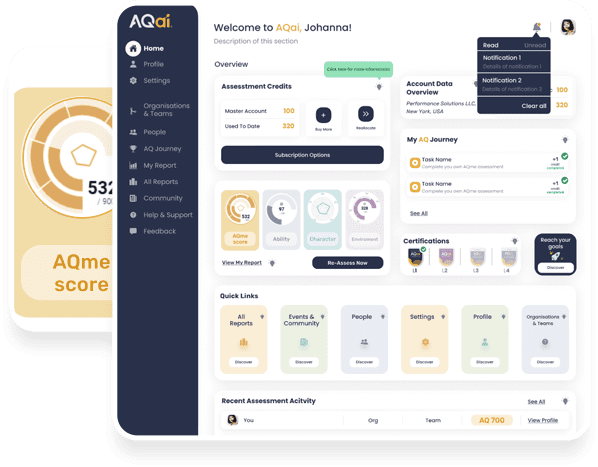
The AQai Team Report is able to not only measure your team’s or organization’s level of grit, but it will also showcase it within the context of other important areas that are relevant to understanding adaptability.
When we looked at the difference between two gritty organizations (Netflix and Blockbuster), their strategies differed in how they viewed the future.
- Blockbuster couldn’t see a future without storefronts (Adaptability triats required: Unlearn, Mental Flexibility, Work Environment)
- Netflix dug into their mission, but only after they realized they couldn’t sell their company (Resilience, Hope, Team Support, and Mindset).
In this single example, it’s important to see why the context of the other adaptability abilities, characteristics, and environment are important to measure and monitor.
What is the Difference Between Grit and Mindset?
Both Mindset and Grit are abilities that you can develop.
Angela Duckworth is a leading researcher and author of the book called Grit. She describes Grit as the “intersection of Passion and Perseverance.”
Carol Dweck is the leading voice and researcher on Mindset. Dweck’s book, called Mindset, details the difference between a Growth Mindset and a Fixed Mindset.
- Growth Mindset: Approaches failure as information or a “not yet” moment.
- Fixed Mindset: Sees failures as a threat to identity.
How does Mindset differ from Grit?
Grit is the sustained drive towards a goal, where mindset concerns the perception of individual challenges (which can ultimately affect your grit).
| Feature | Growth Mindset (Carol Dweck) | Grit (Angela Duckworth) |
|---|---|---|
|
Nature |
Ability |
Ability |
|
Focus |
How you perceive Capability. |
How you apply Effort. |
|
Target |
Learning and Improvement. |
Long-term Achievement. |
|
Internal Dialogue |
“I can learn this if I try.” |
“I will finish this no matter what.” |
Both concepts are closely intersected. If you have a fixed mindset, you can still have high grit, but you may focus only on areas you feel comfortable performing in or working within.
On the other hand, if you have low grit and a growth mindset, you may excel at exploring many areas without achieving mastery in any one area. The two concepts are closely related, but they offer very different outcomes when they aren’t aligned.
Steps You Can Take to Develop More Grit
According to Duckworth, gritty people tend to follow a specific sequence as they mature in their craft:
Interest: You must find a “calling.” Grit starts with enjoying what you do. However, Duckworth notes that interests aren’t usually found through a “bolt of lightning” moment; they are developed through discovery, followed by a period of development and deepening.
Deliberate Practice This isn’t just “putting in hours.” It is the disciplined effort to improve on your specific weaknesses. Gritty individuals seek out feedback and are obsessed with the “1% better” mentality.
Purpose: This is the shift from “How does this help me?” to “How does this help others?” Duckworth found that while interest is crucial, it is the sense of purpose (the belief that your work matters to the world) that sustains grit over the long haul.
Hope: This isn’t “wishful thinking.” It is a persistent expectation that our efforts will improve our future. It is closely tied to Dweck’s Growth Mindset; it’s the “hope” that if I keep trying, I will eventually find a way through.
Measure Your Grit
Angela Duckworth developed the Grit Scale as a self-assessment tool to measure the two components of grit: Consistency of Interest and Perseverance of Effort.
Below is the standard 8-item Short Grit Scale. To use it, honestly rate how much each statement applies to you. At the end of the survey, you will have a chance to choose if you want to speak to a member of our team on how we can help you bring these concepts to your team or organization.
Instructions: For each of the following statements, choose the response that best describes you. Please answer truthfully and candidly.