Master Workplace Adaptability in 2026

Workplace adaptability is vital to measure and learn in 2026.
Think of workplace adaptability as a “stress test” for team dynamics. When a project pivot occurs or a new technology workflow is introduced, a team’s reaction determines its longevity. How far a team and organization can bend is determined based on their adaptability levels, which are measurable.
However, adaptability is not just about “going with the flow.” Organizations and teams must have structure in order to compete effectively. Highly adaptable teams will respond appropriately to change, whereas low-adaptability teams could be thrown into dysfunction.
There are three core pillars that are present in adaptable organizations and teams:
- Psychological Safety: Members must feel safe to fail fast. If the cost of an adaptive mistake is too high, the team will revert to old habits. Promoting self-awareness and teaching effective communication skills go a long way in this area (this is one reason why we use DiSC Personality Assessments to promote psychological safety).
- Decentralized Decision Making: In 2026 and beyond, speed is a major currency, but so are skills like unlearning and grit. Teams that break usually have a bottleneck; teams that thrive empower individuals to make real-time decisions.
- Continuous Re-skilling: Adaptability has many individual skills that must be trained and developed overtime. High-performing teams and individuals treat learning as a daily operational task rather than an annual box to check. Organizations and teams must understand if the environment is fertile for learning or is too stressed and overburdened.
With this context of Adaptability in mind, we can move on to how you can measure it and predict how ready your teams or organization are for change.
The Workplace Adaptability Model
The Adaptability Quotient (AQ) is a science-backed measure of workplace adaptability.
You can now measure AQ with the AQai assessment and gain team insights with the AQTeam Report.
For years, HR has relied on individual soft-skill improvement (i.e. emotional intelligence, communication, teamwork, etc.), but in an era where technology is reimagining the employee experience, AQ has become a more in-demand skill. The science behind the AQai Assessment model is rigorous, grounded in over 100 scientific publications, and validated with 500,000 data points.
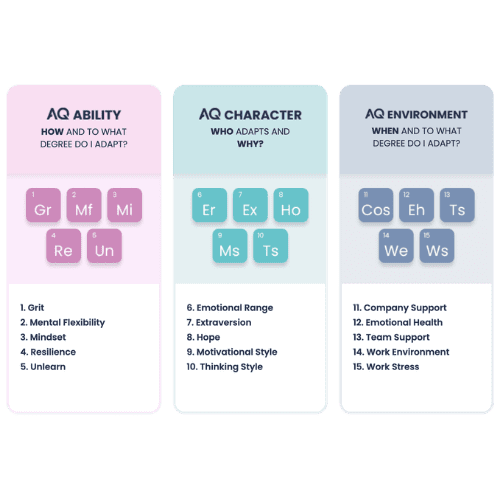
The Workplace AQ model is elegantly simple and deep. The model is categorized into dimensions that are abbreviated by the letters A.C.E.: Ability, Character, and Environment.
- Ability represents how and to what degree someone adapts.
- Character describes who adapts, and they adapt.
- Environment measures the external factors that either help or inhibit your adaptation.
What the Adaptability Assessment Measures
The AQai Workplace Adaptability assessment uses a AI chatbot to deliver the assessment experience. The chart below outlines the sub-dimensions that are measured for each primary dimension group.
| Master Dimension | Definition | Sub-Dimensions |
|---|---|---|
|
Ability |
How and to what degree do I adapt? |
Grit, Mental Flexibility, Mindset, Resilience, Unlearn |
|
Character |
Who adapts and why? |
Emotional Range, Extraversion, Hope, Motivation Style, Thinking Style |
|
Environment |
When and to what degree do I adapt? |
Company Support, Emotional Health, Team Support, Work Environment, Work Stress |
The Ability and Environment dimensions are not fixed. When you complete the AQai assessment, these dimensions can and should change each time you take the assessment. The assessment is designed so you can re-take it and see how these dimensions have changed over time.
The Character dimension measures a person’s personality and refers to how they approach change. Personality research has shown that this area of our identity is mostly stable over time, but it can evolve through learning, experiences, and shifting contexts.
What does the Adaptability Assessment Results Mean?
Each dimension will provide an assessment taker with an adaptability score. Here is an overview of each dimension and sub-dimension’s overall scores and what those scores mean.
Ability Dimension
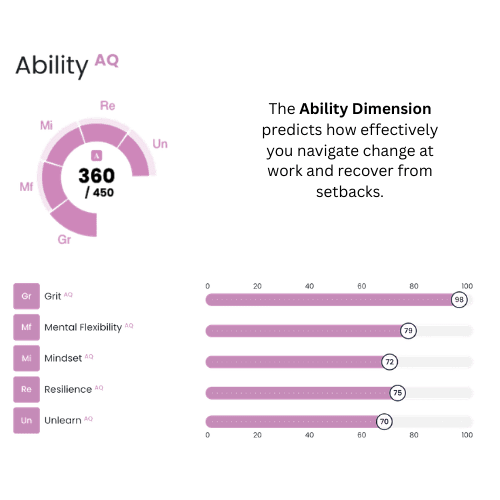
The AQ Ability score predicts how effectively you can navigate change at work and recover from setbacks. It also determines how likely you are to embrace new ideas or perspectives.
This area of adaptabilitywill impact your performance, relationships with colleagues, and overall job satisfaction. It includes Grit, Mental Flexibility, Mindset, Resilience, and Unlearning.
Grit
Grit is your ability to stay committed to long-term objectives. It measures how drive you are by consisten interest and persistent effort. This skill involves a blend of passion and perseverance. Grit is distinct from resilience and is a learnable skill. This ability was brought into the general public through the work of Dr Angela Duckworth from the University of Pennsylvania.
Mental Flexibility
Mental Flexibility is the ability to observe the current situation and embrace competing demands or ideas. It sees tensions as opportunities for learning and growth. It allows for exploration, experimentation, efficiency, and refinement. It goes beyond open-mindedness to actively pursue opposing behaviors and thoughts for greater success through adaptive experiments. Research from Daniel Khaneman and books by Dan Ariely have shed light on decision making and the importance of mental flexibility.
Mindset
Mindset is an AQ Ability that refers to your beliefs and outlook on change. It captures your optimism and wether you visualize positive outcomes. A growth mindset is crucial for thriving in a changing world. This mindset embraces the idea that human attributes can be developed through effort and hard work. Dr Carol Dweck, from Standford University, is the most influential person in teaching about the concepts of fixed and growth mindsets.
Resilience
Resilience is your ability to recover from setbacks and navigate challenges. It allows you to process new information and environmental changes. Research by Martin Seligman at the University of Pennsylvania shows we can develop this skillset. Resilient individuals recover rapidly, experience less stress, and embrace significant transformations.
Unlearn
Unlearn refers to the ability to intentionally let go of outdated information, beliefs, and practices. It allows for new ideas and approaches. Our world is constantly changing, unlearning is a vital component of adaptability and it enables us to remain agile and competitive. This conscious process involves re-evaluating based on new data and environmental factors. It can be discomforting as it requires us parting with past experiences and beliefs. Adaptable individuals identify areas of struggle and uncertainty and update their perceptions, knowledge, and behaviors as needed. Marshal Goldsmith is a pioneer in this work and has written extensively on this subject.
Character Dimension
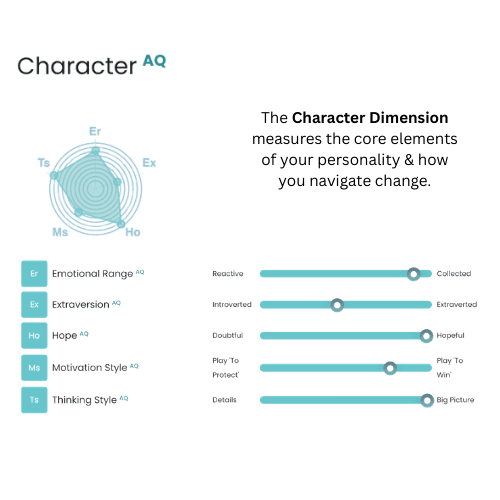
The Character Dimension of the AQAai assessment measures the core elements of your personality in terms of how you navigate change. By understanding your character index, you can learn effective communication and progress towards desired outcomes.
The dimensions are measured on a preference scale, and it incorporates research from two of the Big Five personality traits (Extraversion and Emotional Range) alongside Hope, Motivation Style, and Thinking Style.
Emotional Range
Emotional Range is based on the concept of neuroticism on the Big Five scale. It looks out how individuals experience emotions due to situations in their environment; particularly in the workplace. The range is scored on a sliding scale between Reactive and Collected. There is no ‘right’ or ‘wrong’ side of the scale. Rather, by understanding your typical reaction to change, you can learn to choose a more appropriate response.
Extraversion
Extraversion influences your enthusiasm and energy in social situations. This area of your character affects your decision making and adaptability. Extroverts gain energy for social interactions while introverts are drained by them. On the DiSC model, this would be the range between a C-Personality Style and an i-Personality Style.
Hope
Hope is a measurable psychological state. It’s the mindset to pursue goals and create alternative ways to reach them when they are challenged. Hope consists og agency (goal-directed energy) and pathways (planning to meet goals). Hope emphasizes how we generate strategies to overcome obstacles. In the AQ model, it’s a powerful dimension associated with self-esteem, positive affect, and self-efficacy. It can be negatively correlated with negative emotions and burnout.
Motivation Style
Motivation Style measures what drives you to achieve goals and adapt to change. It’s based on regulatory focus theory which has two main systems: “promotion” (maximizing opportunities) and “prevention” (fulfilling duties and minimizing errors). The AQai assessment measures this character trait on a continuum based on “play to protect” (preserving what you have) and “play to win” (motivated by potential gains). By learning your motivational style, you can better understand how to adapt and succeed in changing environments.
Thinking Style
The Thinking Style sub-dimension of your Character explores how you process information, categorize and make sense of the world in your work environment. It looks at how you are balanced between big-picture and detailed thinking.
Environment Dimension
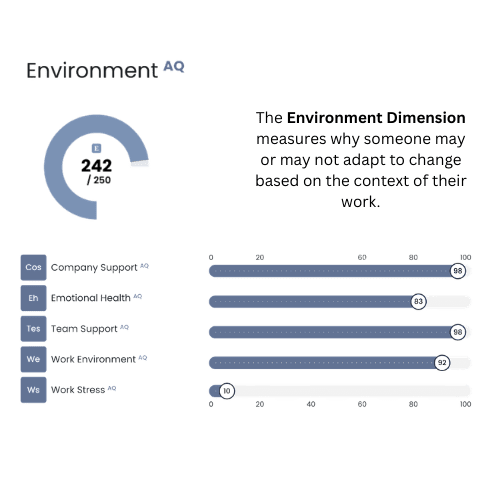
The environment dimension aims to measure the context that may influence whether someone adapts to change. It focuses on looking at Company Support, Emotional Health, Team Support, Work Environment, and Work Stress.
Your AQ Environment Profile reflects how these interconnected dimensions influence your ability to thrive, navigate change, and respond to various situations at work. Supportive environments can boost adaptability, mental well-being, and positive attitudes towards change. Unsupportive ones may hinder progress and growth.
Company Support
Company support measures employee perceptions of how their organization values their contributions and cares for their well-being. Research has shown that high levels of company support correlate with job performance, satisfaction, and lower staff turnover. When employees perceive their organization as supportive and caring, they are likely to adapt to changes and align their personal goals with the company’s.
Emotional Health
Emotional Health measures your ability to thrive at work by regulating your emotions. It’s a crucial skill for adaptability since it influences your energy and engagement in change. Environments with poor emotional health impacts work performance and the ability to adapt to change.
Team Support
Team Support represents the extent to which employees feel comfortable sharing knowledge, addressing challenges, and expressing their opinions within their team. A supportive team environment is crucial for psychological safety, trust, and connection amongst team members. Teams absence of support will hinder adaption and innovation within an organization. Team support should be reassessed regularly to ensure it’s maintained at high levels.
Work Environment
Work Environment assesses the systems, processes, and methodologies in your organization that influence adaptability. Iit evaluates whether your organization fosters self-disruption, experimentation, and adaption. This sub-dimension considers rewards, observable acts, punishment, work spaces, and public celebrations. A beneficial work environment for adaptability is one where failures are viewed as learning opportunities. They are openly discussed and celebrated company-wide. A closed and pragmatic environment hampers adaptability, whereas an open and experimental environment nurtures it.
Work Stress
Work Stress guages the sense of task overwhelm. Managing work stress effectively is crucial for adaptability. High levels will limit your ability to adapt while low levels may reduce the motivation to adapt. A balance of healthy stress, or ‘eustress,’ is vital for growth, adaption, and change. Long-term high work stress can lead to negative consequences such as high employee turnover, poor sleep, sickness, and burnout. Understanding and optimizing work stress is essential to maintain a productive and adaptive workforce.
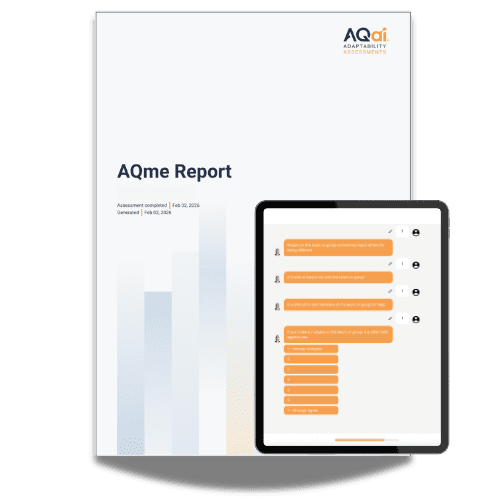
View and download a sample report to see how all of these dimensions and sub-dimensions are presented for individuals seeking to improve their adaptability.
How Measuring Workplace Adaptability Can Predict Organizational Outcomes
After measuring workplace adaptability, you can use those measurements to predict a team’s or the whole organization’s change-readiness and re-skilling capacity.
This ability allows people leaders to be more strategic before a single dollar is spent on a transition or organizational development. Below are some use cases to show how these areas function.
| Prediction Capability | Definition | Impact Example |
|---|---|---|
|
Change Readiness |
The AQ Change Readiness Index™ measures a team’s collective ability to navigate uncertainty by evaluating their combined adaptability skills alongside the strength of their organizational support systems. |
During the COVID-19 Pandemic, organizations with high-change readiness immediately began to re-assess their business strategies. They recognized the challenges ahead, but they didn’t panic. Examples include restaurants that built lavish outdoor seating, to-go cocktail menus, and game-based meals. |
|
Reskill Index |
The AQ Reskill Index™ is the rate of a team’s professional growth. It isn’t just about “learning new things”; it’s about the emotional and cognitive capacity to let go of what no longer works. |
Michael Lewis’ bestselling book Moneyball shows how the AQ Reskill Index can introduce new competitive advantages without more costs. Today, professional sports all leverage teams of data analysts to gain an advantage over opponents, but this reality is because of one man, Billy Beane, who wanted to challenge the thinking around how to scout talent in the first place. |
The AQ data is available, so you can see how your employee demographics compare across these areas. You can look at gender, age, geographies, position/occupation, job level, and work tenure.
This ability to sort and review different levels of data can be helpful not only understand change readiness but also to determine how well your organizational goals are progressing.
How to Start Improving Workplace Adaptability
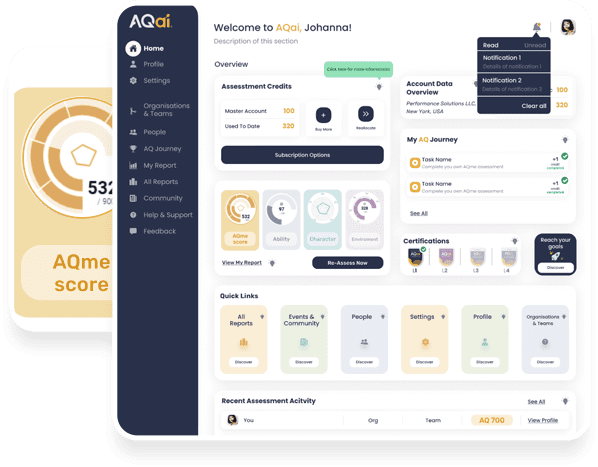
The AQai assessment and online platform offer a robust option for measuring and improving workplace adaptability. The tool can be used by internal practitioners, or you can work with our organization to meet with an organizational strategist or coach to help improve workplace adaptability.
Are you interested in learning more about your workplace’s adaptability score? Fill out the form below to tell us a little about your organization and what you hope to accomplish. We will be in touch soon!