What is DiSC?
Read our Guide to this powerful tool.

What is the DiSC Personality test? DiSC is an assessment that measures an individual’s behavioral style. It can help individuals unlock their leadership potential and it can also improve how individuals and teams communicate. This assessment was used by over 40 million people. Each year, over 1 million people complete an Everything DiSC assessment. It can help improve workplace culture and reduce employee stress.
Everything DiSC is built on a long history of research. It was first designed as a paper and pencil assessment in the late 1970s. It was one of the first tools to move online in the late 1990s, and, today, Everything DiSC is the only DISC-based assessment to use Computerized Adaptive Testing for increased accuracy and personalization. Organizations and teams use DiSC to:
- Improve teamwork
- Build culture
- Develop leaders
- Increase employee engagement
Does DiSC measure personality?
DiSC is often called a personality assessment. It’s important to clarify that DiSC measures behavior. Personality encompasses a lot of traits. However, we often associate someone’s personality from their common behaviors. As an example, we would expect that a person with a dominant personality would be quick to act. They might be outspoken and freely express their opinions. These are measurable behaviors. DiSC provides insights to help someone understand their own behavior and the behaviors of their co-workers, friends, and family.
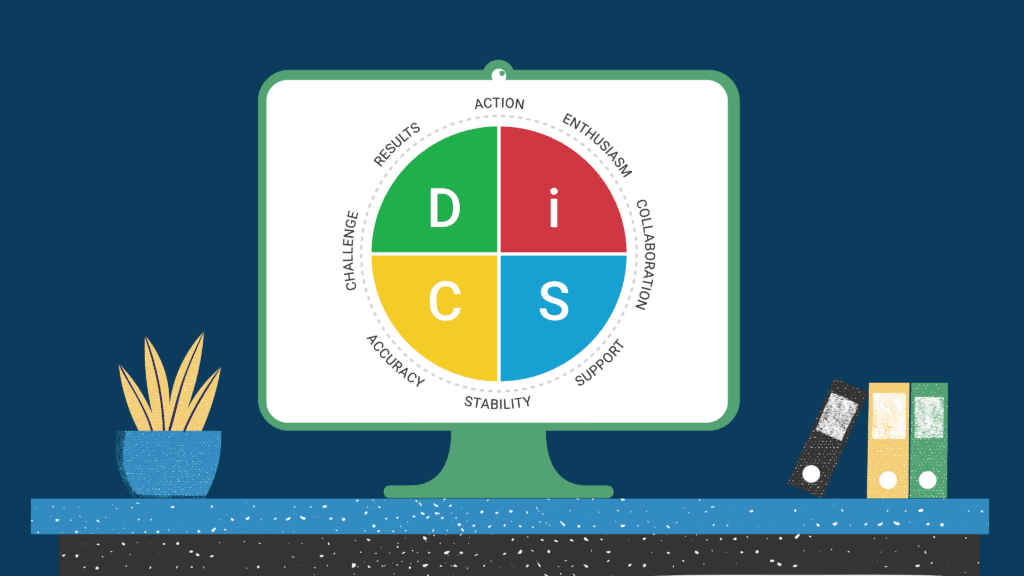
DiSC is an acronym, and the letters D, I, S, and C stand for a specific behavioral style. Below is the name and an outline of each style:
- D – (Dominance / D Personality Type): To the point, decisive, and bottom-line oriented. These people tend to be independent and results-driven. They are strong-willed people who enjoy challenges, taking action, and achieving immediate results.
- I – (Influence / i Personality Type): Optimistic and outgoing. These people tend to be highly social and outgoing. They prefer participating in teams, sharing thoughts, and entertaining and energizing others.
- S – (Steadiness / S Personality Type): Empathetic & Cooperative. These people tend to be team players and are supportive and helpful to others. They prefer being behind the scene while working in consistent and predictable ways. They are often good listeners and avoid change and conflict.
- C – (Conscientiousness / C Personality Type): Concerned, Cautious & Correct. These people are often focused on details and quality. They plan ahead, constantly check for accuracy, and want to know “how” and “why”.
Often, DiSC is associated with these four primary styles (personalities) of D, I, S, C. However, Everything DiSC measures 12 different personality styles. Here is a brief overview of the other styles:
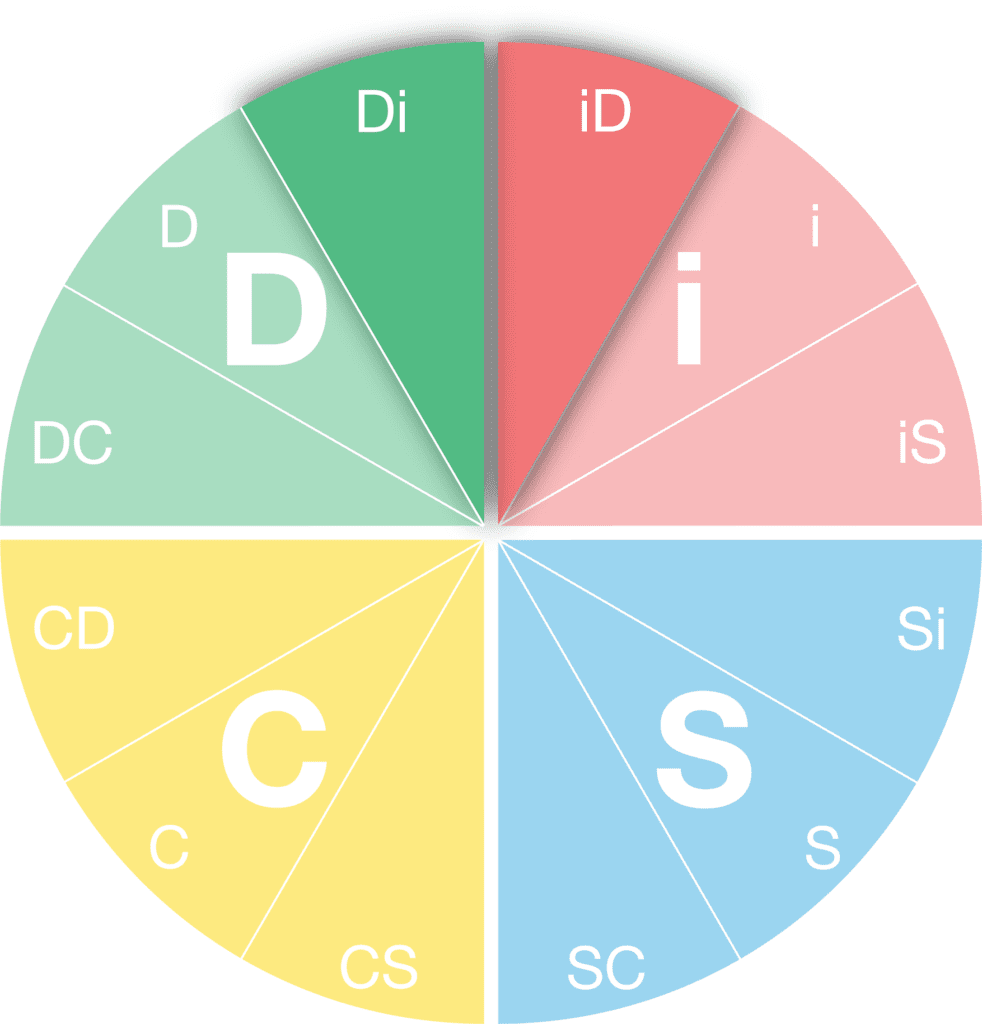
Di / iD Style - Dominance / Influence
People who fall in this location on the map describe themselves as adventurous and bold. They are more likely than the average person to identify themselves as enterprising or entrepreneurial. Both Styles share the behavior of being action-oriented. However, a person with an iD style will lean more towards focusing on a relationship over a task. A person with the Di style will focus more on a task over a relationship.
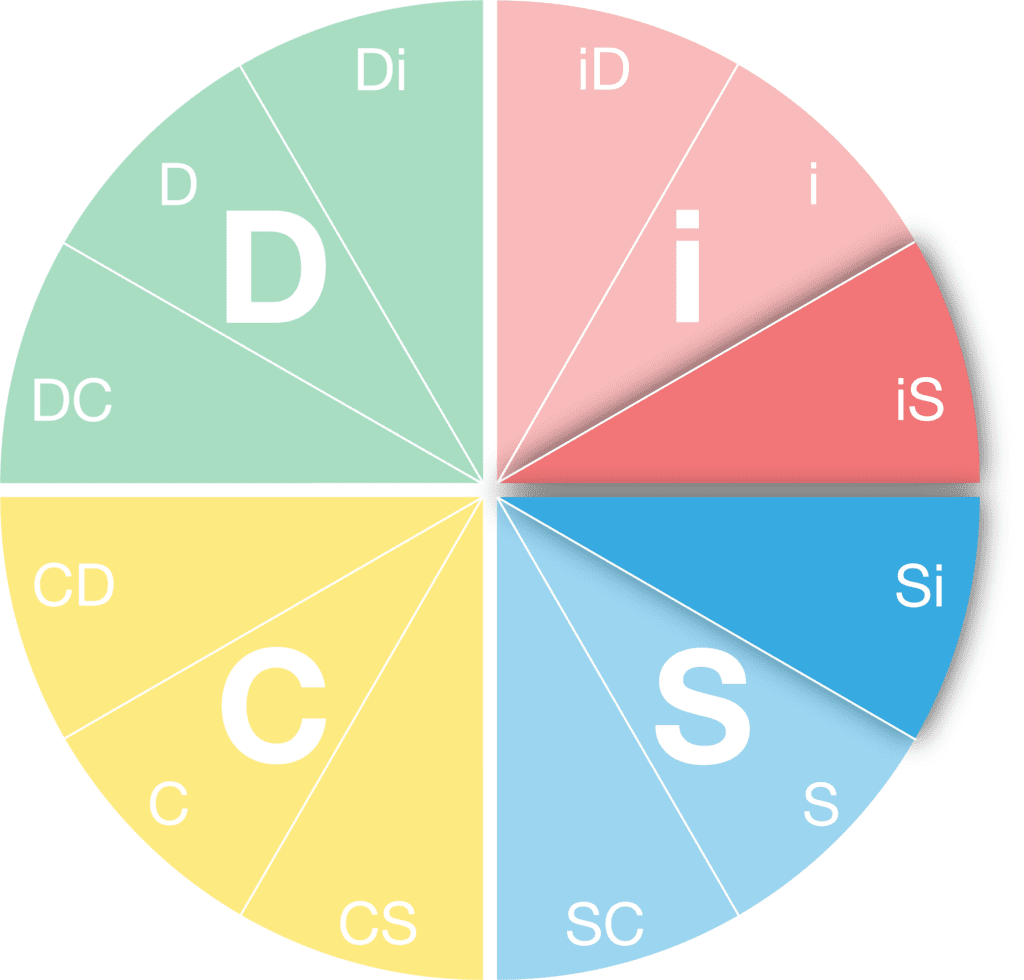
iS / Si Style - Influence / Steadiness
The word ‘gentle’ is a prominent way to describe those that have these personality types. Another way is ‘cheerful’. In general, people who have these styles are trusting and see the best in others. Both styles share the trait of being focused on relationships. They will put people first. However, a person with the iS Style will act at a quicker pace or will take more risks in their behaviors. A person with the Si style will move at a slower pace and be more risk-adverse.
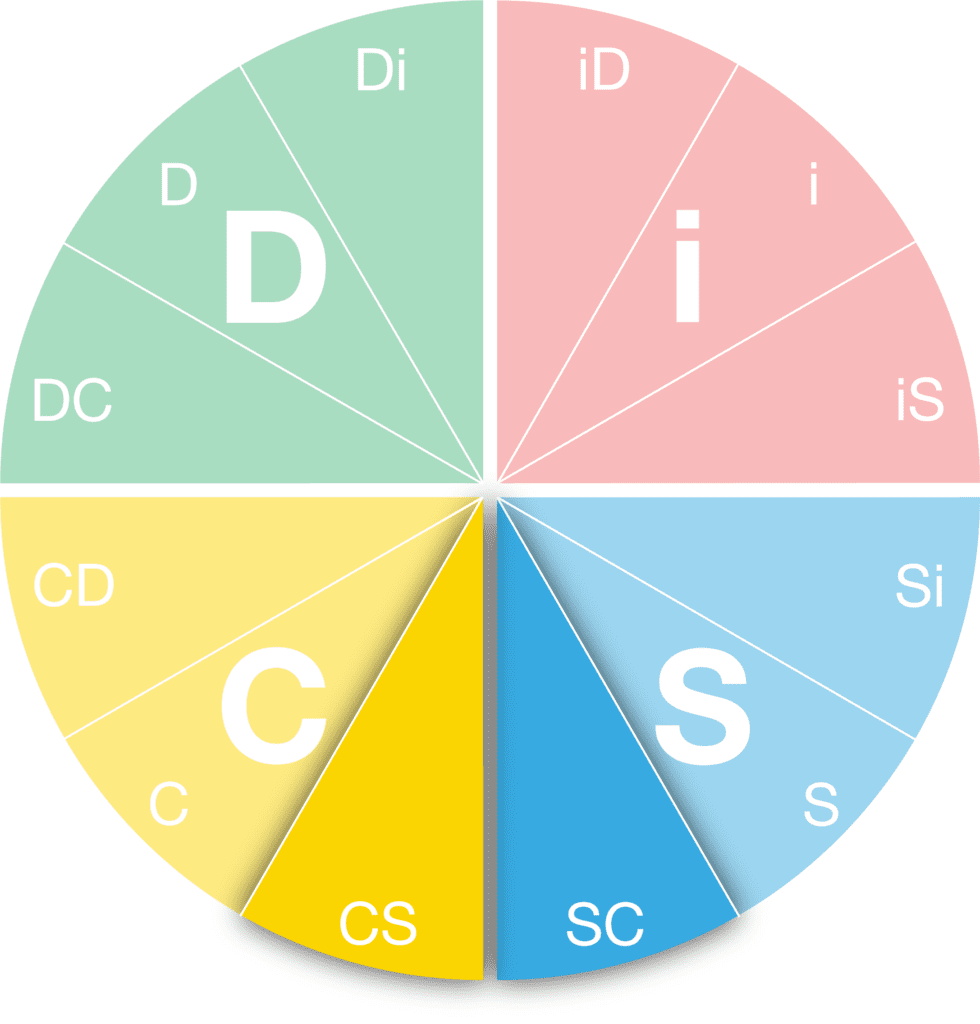
SC / CS Style - Conscientiousness / Steadiness
Those that have the SC or CS style are the least prone towards action and more likely to deliberate on their options. They are careful in their decision-making and describe their pace as steady and step-by-step. Compared to the average person they show less outward energy. Both styles share the behavior of behaving cautiously and being risk-averse. However, a person with the SC style will focus on their attention relationships over tasks. A person with the CS style will focus more on tasks over their relationships.
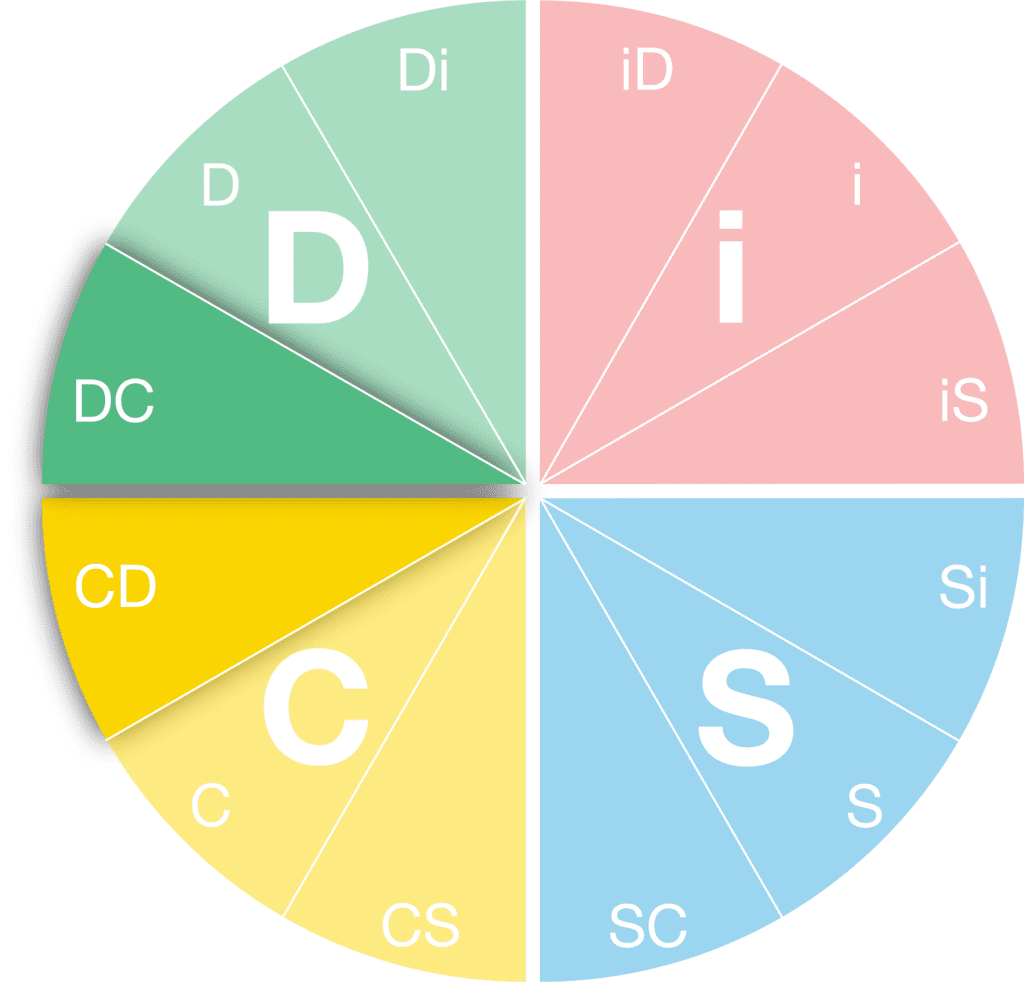
CD / DC Style - Conscientiousness / Dominance
A person who falls into this category is more skeptical than the average person, but not to the extremes of being either highly aggressive or withdrawn. The word challenging is frequently used to describe a person with these styles. Both styles share the common behavior of being task-oriented. When a problem arises, they will be very focused on solving it. However, a person with the CD Style will move more cautiously when trying to solve a problem or complete a task. Someone with the DC Style will be more dynamic and more willing to take risks when working on a problem or a task.
Is DiSC similar to Myers-Briggs or other Personality Assessments?
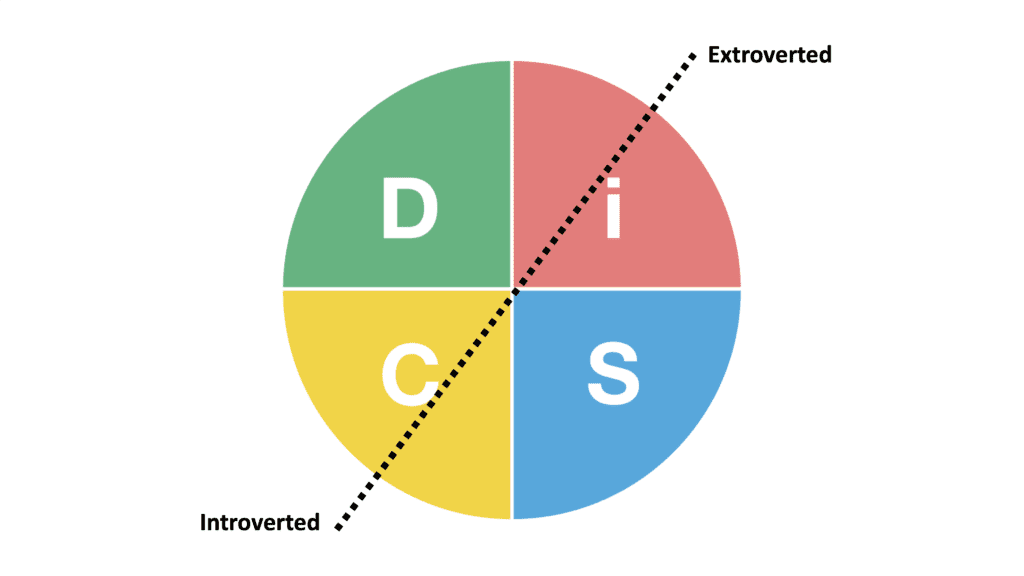
Today, there are many assessments that help promote personal development, organizational culture, leadership development, and team building. Often, DiSC is compared to the Myers-Briggs (MBTI) assessment because of the overlap between Thinking / Feeling (DC/CD – iS/Si style) and Extroverted / Introverted (i-Style / C-Style) scales.
Introverted/Extroverted Scale vs DiSC
Thinking/Feeling Scale vs DiSC
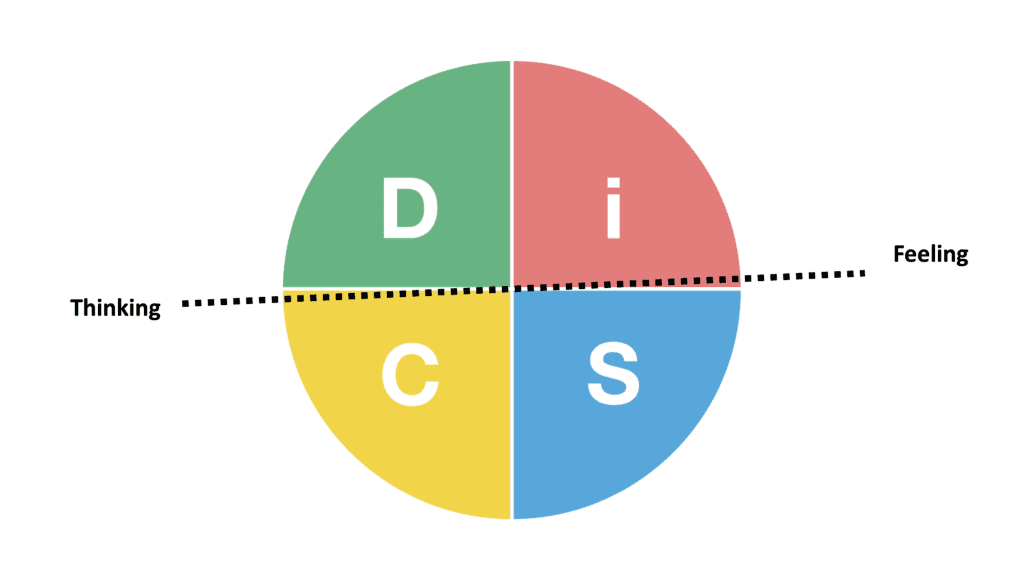
Myers-Briggs and DiSC are not related even though there is a strong relationship between how these two tools measure these specific scales. We have found that, compared to Myers-Briggs, DiSC affords learners a simple yet effective language to describe behaviors.
As an example, a person with the i-Style is extroverted. However, DiSC allows a person with an i-Style to recognize how aligned they are with their own style by the placement of a dot on the graph. If a person has a dot closer to the edge of the graph, they are more aligned with their style. The closer to the center of the graph, the less inclined they are with their style. This reference isn’t available with MBTI. A person who receives their style of ENFJ knows they are Extroverted, but they don’t know how much. DiSC provides that nuance.
Additionally, each tool differs in how a person is assessed, researched, and used within a developmental setting. Myers-Briggs / MBTI is used in many different capacities. DiSC is only validated for use in training and development, and should never be used for hiring or selection.
DISC begins with a theory...
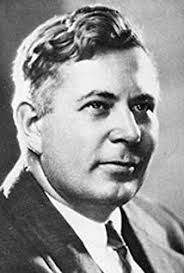
Every DISC assessment is based on the research of William Moulton Marston, Ph.D. (1893-1947).
Marston was influenced by his contemporaries such as Carl Jung and Sigmund Freud, who were focused on diseases that affected people’s behaviors. In contrast, Marston sought to develop a theory explaining the behavior of “normal” or healthy people within a specific situation or environment. Marston studied the behaviors of people in prisons and colleges. He categorized people into four distinct emotional behaviors. He found that people could be categorized into four different emotional states:
- Dominance
- Compliance
- Inducement
- Submission
Marston described his findings in a book called The Emotions of Normal People.
Marston never designed an instrument to measure his theory. For this reason, there are many versions of DISC.
He wrote this book in order to develop a theory to support his invention of a lie detector test. Marston worked from the time he was an undergrad at Harvard throughout his time as a professor working to develop something that would help prove if someone was lying. The Supreme Court ruling of Frye v. United States is directly tied to Marston and his lie detector test.
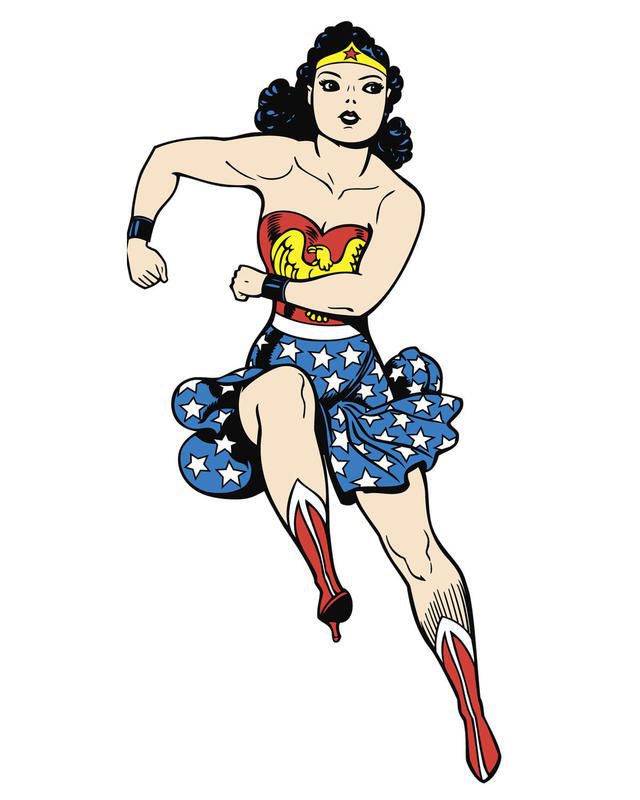
In addition to his work on the emotional behaviors of individuals and developing a lie detector test, Marston’s work of Wonder Woman is the most recognized.
DISC, D.I.S.C, or DiSC? What's the difference?
While Marston created DISC theory, he never intended to use it as an assessment for personal development. For this reason, Marston’s theory is used by many different DISC-based assessments or other four-quadrant assessments. The first assessment that used Marston’s DISC Theory was the Activity Vector Analysis (AVA) which was developed by Walter Clarke in the 1940s.
Clarke was trying to develop an assessment that would help identify a way to predict job fit. During his research, Clarke saw that his assessment data matched Marston’s theory. He used his data to provide empirical evidence that DISC theory was viable in helping to categorize a person’s behavioral style.
Today, the most widely used DISC assessment is published by John Wiley & Sons. You can recognize their assessment because they have trademarked the lower-case ‘i’ in DiSC. However, there are many other versions of DiSC. Extended DISC, Take Flight with DISC, and Crystal Knows all use Marston’s theory. However, each provider researches and validates their assessment differently.
We represent the DiSC assessment with the lowercase ‘i’ in DiSC® because it provides more reliable, accurate, and added value resources to help a person use DiSC to improve their interpersonal relationship.
Review the full DiSC Timeline
It wasn't until the 1970's that the assessment we know today was created. Read the full timeline.
DiSC TimelineCircle Graph or Line graph? What's the difference?
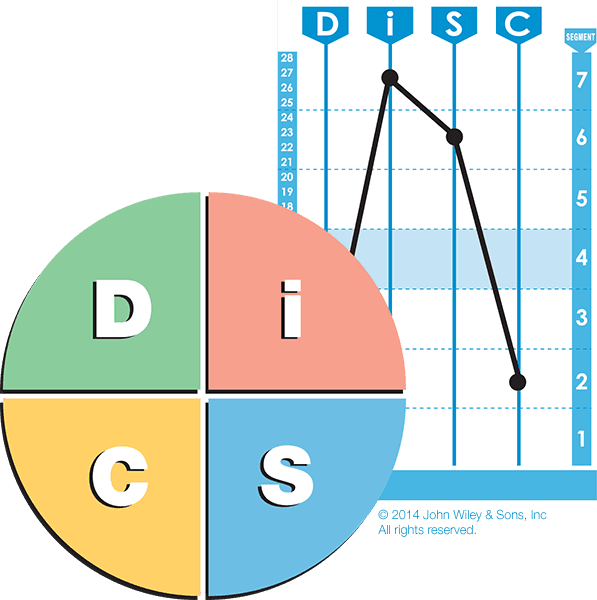
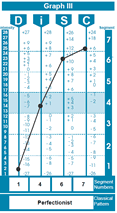
In the 1970s, the first DiSC assessment asked learners to read 56 adjectives and choose the best one that they felt described themselves. After they completed this questionnaire, they would tally up their score based on their answers. This score would allow them to plot their DiSC Style using a Line Graph. For decades, this was the only way that a person was able to receive their personality style. Today, learners can still complete a Paper Profile or the online assessment which is called DiSC Classic 2.0.
In 2007, John Wiley & Sons (previously called Inscape Publishing), started to develop a circular graph called a circumplex. Researchers at Wiley were evaluating how they could personalize the DiSC Profile and they recognized that the circumplex aligned better with how Marston envisioned a person’s personality. Marston describes his theory as a color wheel. While we all have a primary color, our color blends with other styles that we use in certain situations.
Transitioning from a line-graph model to the circumplex not only allowed Everything DiSC to align closer with Marston’s model, it also improved the accuracy of the report. Everything DiSC is 32% more accurate when compared to the line-graph or DiSC Classic model.
Taking a DiSC Assessment
What to expect when you complete an assessment
It’s important to know that there are no right or wrong answers when completing a DISC assessment. Similarly, there are no better or worse DISC styles. If you are asked to complete an assessment, or if you are asking others to complete an assessment, the best results are when the assessment is answered honestly and candidly. Most DISC assessments use a 28-questionnaire to determine a person’s DISC Style. The DiSC Classic 2.0 (which is the pre-cursor to Everything DiSC), also used this assessment method.
However, Everything DiSC uses an assessment process called adaptive testing. One learner might receive different questions from another learner because of this process. Rather than giving 28 questions, Adaptive Testing pulls for over 100 questions. One learner might receive 30 questions, and a different learner might receive 45 questions depending on how they answer the assessment. This process also cuts down on the assessment time.
Typically, any DISC assessment will take 20-30 minutes to complete.
How are DiSC Tests scored?
Everything DiSC is a self-assessment. This means that it will use data provided by the user completing the assessment (unless you are using an Everything DiSC 360 feedback tool). Once a user completes their self-assessment, the assessment is measured against the 8 different Everything DiSC scales (D, Di/iD, iS/Si, S, SC/CS, C, CD/DC). Depending on how many questions a person answers that are associated with these scales, they will receive one of the 12 Everything DiSC Styles.
While Everything DiSC uses an advanced assessment process, anyone can generally place themselves by answering a few simple questions. DiSC measures two primary behavioral traits:
- Pace: Are you quick to action, or more cautious? Do you take risks, or are you more risk-averse?
- Task: Do you tend to focus on the task at hand, or do you prefer to solve issues by connecting people to the issue?
There are many nuanced questions to help a person determine their actual DiSC style. Everything DiSC pools from over 100 questions to help a person determine their style.
Are you skeptical or trusting?
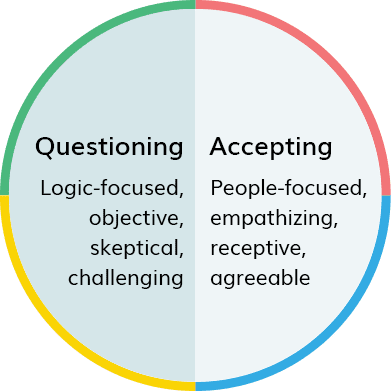
If you use logic to solve problems, are skeptical of solutions other than your own, and challenge the opinions of others you fall on the ‘Questioning‘ side of the DiSC model.
If you want to connect people together, you are empathetic and receptive to outside ideas and opinions, you fall on the ‘Accepting‘ side of the DiSC model.
Are you quick to take action, or more cautious?
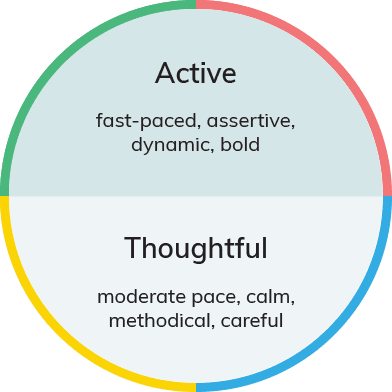
If you take risks, use your gut to make decisions, and generally make bold choices you are on the ‘Active’ side of the DiSC Model.
If you are more cautious and risk-adverse, and you try to collect information prior to making a decision you are on the ‘Thoughtful‘ side of the DiSC Model.
This simple exercise will help someone identify their primary DiSC Quadrant. Here are all of the possible combinations:
- Questioning and Active – D-Style
- Accepting and Active – i-Style
- Accepting and Thoughtful – S-Style
- Questioning and Thoughtful – C-Style
Please know that there are many nuances to discover your behavioral style. An actual Everything DiSC assessment will pull from over 100 questions to help someone determine their actual DiSC style. This simple exercise is meant to just help you understand how DiSC can provide some basic insights for anyone.
How to start using DiSC
Personalized profile + Facilitated workshop = Best results
Everything DiSC’s primary goal is to improve interpersonal relationships. When this happens, team culture, communication, and engagement also improve. While Everything DiSC offers the most personalized report compared to other DISC tools, it is best used during a facilitated workshop. Research has found that when a learner interacts and uses new information, they are more likely to retain that information. Everything DiSC facilitation programs are designed with this research in mind. During a facilitated program, learners will:
- Join small group and 1:1 discussions
- Complete activities using their personalized report
- Watch videos that supplement information from their profile
Everything DiSC training programs move away from having a facilitator teaching about DiSC. Rather, they set up space and activities to have learners interact with each other using their personalized information in their reports. For certain applications, learners also have access to a new learning platform called Everything DiSC Catalyst where they can explore the content of their report on an engaging web experience.
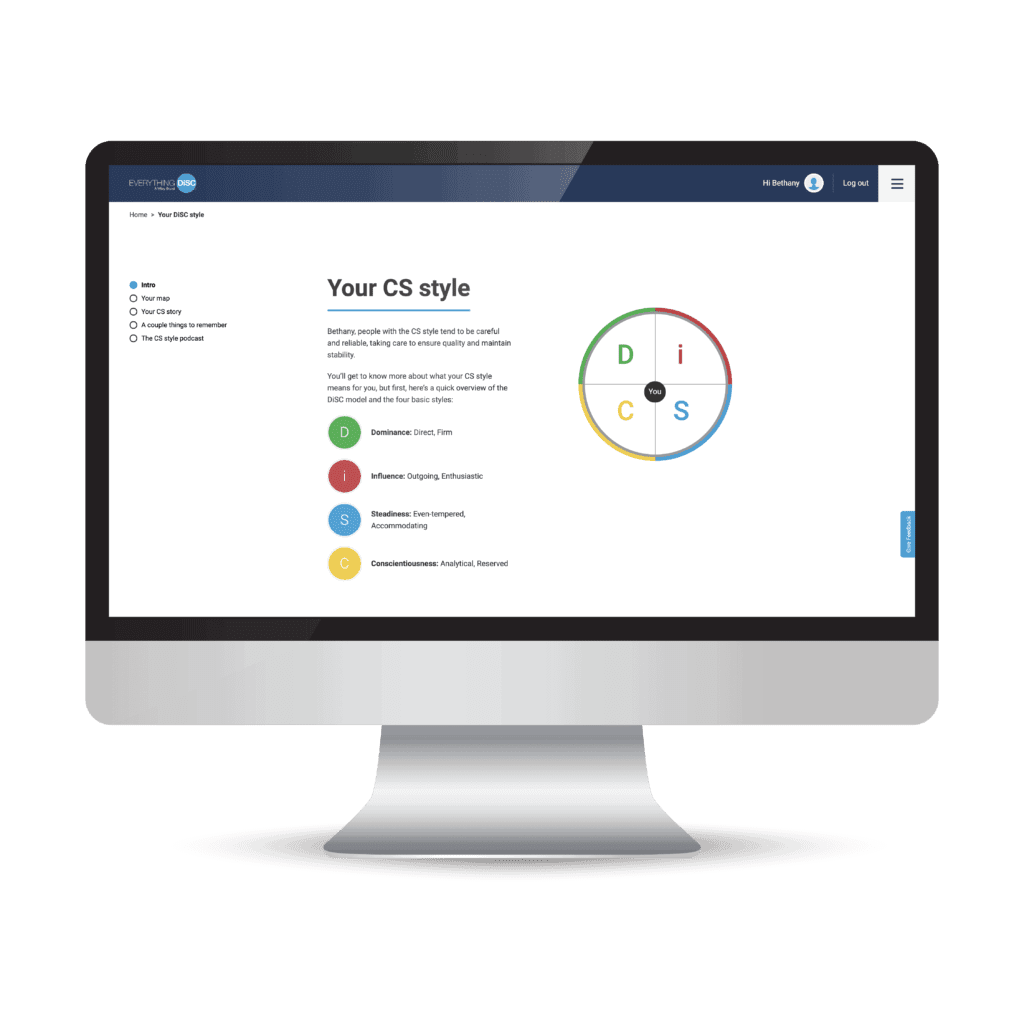
Everything DiSC Catalyst
Learn about the new way to learn your style and about how to use the model on this interactive platform.
Buy the Facilitation Program
Coaches, trainers, or learning & development professionals who want to use DiSC with clients or employees should consider purchasing the Everything DiSC facilitation program. This kit includes a fully developed DiSC Workshop.
Purchase the DiSC Profile
If you are looking to buy the DiSC Profile to learn more about yourself and others, get started with Everything DiSC Workplace.
How we use DiSC
Center for Internal Change offers 30+ years of DiSC Experience

Center for Internal Change is a division of The TEAM Approach. Our firm was started in 1986 with one mission: Improve teamwork through better relationships.
We first started using DiSC when it was only offered as a paper instrument. While the technology in delivering these tools improved, our mission remains the same. If you are a coach, HR Professional, or Learning & Development professional, we offer our many years of experience helping to implement DiSC.
Furthermore, we offer supplemental solutions that enhance the delivery of these tools. We provide train-the-trainers, Everything DiSC Certification, and free supplemental tools that we have developed like our Team Leader Support kit. We are more than an assessment provider. We are constantly looking to improve who these tools are used and implemented. We frequently partner with the publishers of the tools we represent to beta test new products.